Body Doubling: What It Is, Why It Works, and How to Do It
You already know body doubling works — you've done it at a coffee shop, a library, or sitting next to a friend while you both worked on completely different things. Something about having another person nearby made the report easier to start, the admin pile easier to face, the afternoon less likely to slide into nothing.
That feeling has a name. Body doubling is the practice of working on a task while another person is present — not helping you, not supervising you, just there. And it works whether or not you have ADHD, whether your body double is in the same room or on the other side of the world, and increasingly, whether or not they're even on camera.
This post covers what body doubling is, why it works (and what the research actually says), who benefits from it, and six practical ways to do it — including online options that don't require you to be on video.
What Is Body Doubling?
Body doubling means working on a task while another person is physically or virtually present. The body double isn't a collaborator or an accountability coach — they're simply doing their own thing nearby. Their presence is the mechanism, not their attention.
The term originated in ADHD coaching circles. Linda Anderson at ADDA, drawing on 23 years of coaching experience, first described it as a structured technique: someone sits with a person with ADHD while they work, not to help or supervise, but to anchor their focus through shared presence.
It's worth separating body doubling from a few adjacent concepts. It's not collaboration — your body double isn't working on the same thing. It's not accountability coaching — they're not checking your progress. And it's not the film industry term where a "body double" stands in for an actor. If you arrived here from that angle: you want IMDB, not this post.
The practice also goes by other names — parallel working, virtual co-working, the accountabilibuddy model. The name doesn't matter much. The mechanism does.
Citation capsule: Body doubling is a technique, originating in ADHD coaching, where a person works on their own tasks while another person is present — not helping, just there. The body double's presence acts as an external anchor for attention and task initiation. The term was coined by ADHD coach Linda Anderson and is documented in the ADDA framework. It is distinct from collaboration, coaching, or supervision.
Why Does Body Doubling Work? The Science
The honest answer: we don't have large-scale randomized controlled trials on body doubling specifically. What we do have is strong theoretical grounding in decades of established psychology, plus two recent studies that add direct evidence.
The deepest root is social facilitation theory, first described by Norman Triplett in 1898 and formalized by Robert Zajonc in 1965. Zajonc's insight was clean: the mere presence of another person increases physiological arousal and improves performance on familiar tasks. Over 60 years of replication across different contexts have held up the core finding. Body doubling applies this principle directly to knowledge work — having someone nearby raises the baseline activation your brain brings to the task.
The second mechanism is dopamine and social presence. For people with ADHD, lower baseline dopamine makes self-initiated focus genuinely harder, not a character flaw. Research on social encounters activating the brain's dopamine reward pathway suggests that another person's presence may partially fill that gap. J. Russell Ramsay at the University of Pennsylvania's Perelman School of Medicine has described body doubling as a form of "externalizing motivation" — an evidence-based approach for ADHD where environmental structure does some of the regulatory work the brain struggles to do alone.
A third explanation comes from polyvagal theory: nervous systems regulate in relationship. Shared space — even virtual shared space — can shift someone from hyperarousal (scattered, anxious) or hypoarousal (flat, avoidant) into a calmer, more engaged state.
On the direct evidence side: a 2023 ACM SIGACCESS study by Eagle, Baltaxe-Admony, and Ringland surveyed 220 neurodivergent participants and produced the first formal academic investigation of body doubling as a continuum. A 2024 study via Neurodiversity.org, tracking 117 adults over 12 weeks, found that virtual body doubling helped participants sustain focus for 60+ minutes — up from under 30 minutes before they started.
Neither study is definitive. Both are promising. The research base is young; the theoretical backing is decades deep. That's a reasonable basis for trying something.
Citation capsule: Body doubling is grounded in social facilitation theory (Zajonc, 1965) — the finding that the mere presence of others improves performance on familiar tasks, replicated over 60 years. A 2023 ACM SIGACCESS study (n=220 neurodivergent participants) and a 2024 Neurodiversity.org study (n=117 adults, 12-week tracking) provide emerging direct evidence. No large-scale RCTs exist; the evidence base is emerging, not definitive.
Who Benefits from Body Doubling?
Body doubling started in ADHD communities, and that's still where it's most discussed. Task initiation and sustained attention are exactly the friction points it addresses — and for people with ADHD, those friction points are structural, not motivational. Dr. Michael Manos at the Cleveland Clinic describes it as one of the more practical behavioral strategies available precisely because it doesn't require willpower to work.
But ADHD is the origin, not the boundary.
Remote workers face a version of the same problem. Office environments provide ambient social presence as a default — background noise, visible colleagues, subtle norms about when you're supposed to be working. Remote work strips all of that out. 46% of UK remote workers report loneliness as a significant problem, according to WorkLife's 2023 reporting. Body doubling recreates the ambient social layer without requiring actual interaction.
Students have been doing this for generations — library sessions, study groups, campus coffee shops. The environment changes; the mechanism is the same. Virtual study rooms extend it to anyone, anywhere.
Freelancers and solopreneurs have no team, no office, and no external structure. Body doubling fills the accountability gap that a regular job provides invisibly.
Anyone procrastinating on a specific task — taxes, email inbox, admin work — benefits from the low-friction version: a focused body doubling session with a timer and a declared goal. The bar to benefit is lower than most people expect.
For a deeper look at the ADHD-specific research and why body doubling works differently for neurodivergent brains, see Body Doubling for ADHD: Why It Works and Where to Start.
How to Body Double: 6 Practical Methods
There's no single right way to body double. The best method is whichever one removes enough friction that you'll actually use it. Options range from walking to a coffee shop to joining a camera-free virtual room — all of them work through the same core mechanism. Here they are, ordered from lowest setup to highest.
1. Work in a public space. Coffee shops, libraries, coworking spaces. No app, no scheduling, no technology. You walk in, find a spot, and the ambient presence does the rest. The Cleveland Clinic identifies this as one of the most accessible entry points. The limitation is physical: you have to leave the house, find a spot, deal with noise variability.
2. Call a friend. Phone or video call while you both work on your own things. Set a timer, share what you'll work on at the start, check in briefly at the end. This requires finding someone with compatible availability — which is often the main friction.
3. Join a virtual coworking room. Platforms built specifically for this: Focusmate, Flow Club, Flown, BuckleTime, Deepwrk, presence. These give you structure (timed sessions, start/end rituals) and a pool of available partners without having to coordinate with friends.
4. Use a "study with me" livestream. YouTube and TikTok have hundreds of channels — people broadcasting themselves studying or working in real time. Free, zero friction, available 24/7. The limitation is that it's one-directional: you see them, they don't see you, so there's no accountability loop. It works better as ambient presence than as active body doubling.
5. Start an accountability group. A recurring session with 2-4 people on a regular schedule. Catherine Mutti-Driscoll at the Hallowell Todaro Center describes the model: brief goal-sharing at the start, quiet focused work, check-in at the end. More setup, but more consistency once it's running.
6. Try a camera-free focus room. For people who find video calls more draining than energizing, camera-free options skip the video entirely. Ambient presence through status indicators, shared timers, or breathing animations replaces faces on screen. Research on Zoom fatigue finds that 49% of Americans report video calls more exhausting than in-person meetings — for those people, turning the camera on can undermine the focus benefit rather than support it.
For free options across these methods, see Body Doubling Online for Free: 7 Ways to Get Started.
Body Doubling Online: What to Look For
Not every virtual body doubling platform works the same way. The right choice depends on whether you need structured sessions or drop-in flexibility, whether camera presence helps or hurts your focus, and how much you want to pay. A few dimensions separate tools that actually work from ones that add friction.
Session structure. Some platforms use timed sessions with explicit start and end rituals — you book a slot, show up, and leave when the timer ends. Others offer drop-in rooms where you come and go as needed. Timed sessions add external deadline pressure, which helps with task initiation. Drop-in rooms offer flexibility, which helps when your schedule is irregular. Neither is better; they solve different problems.
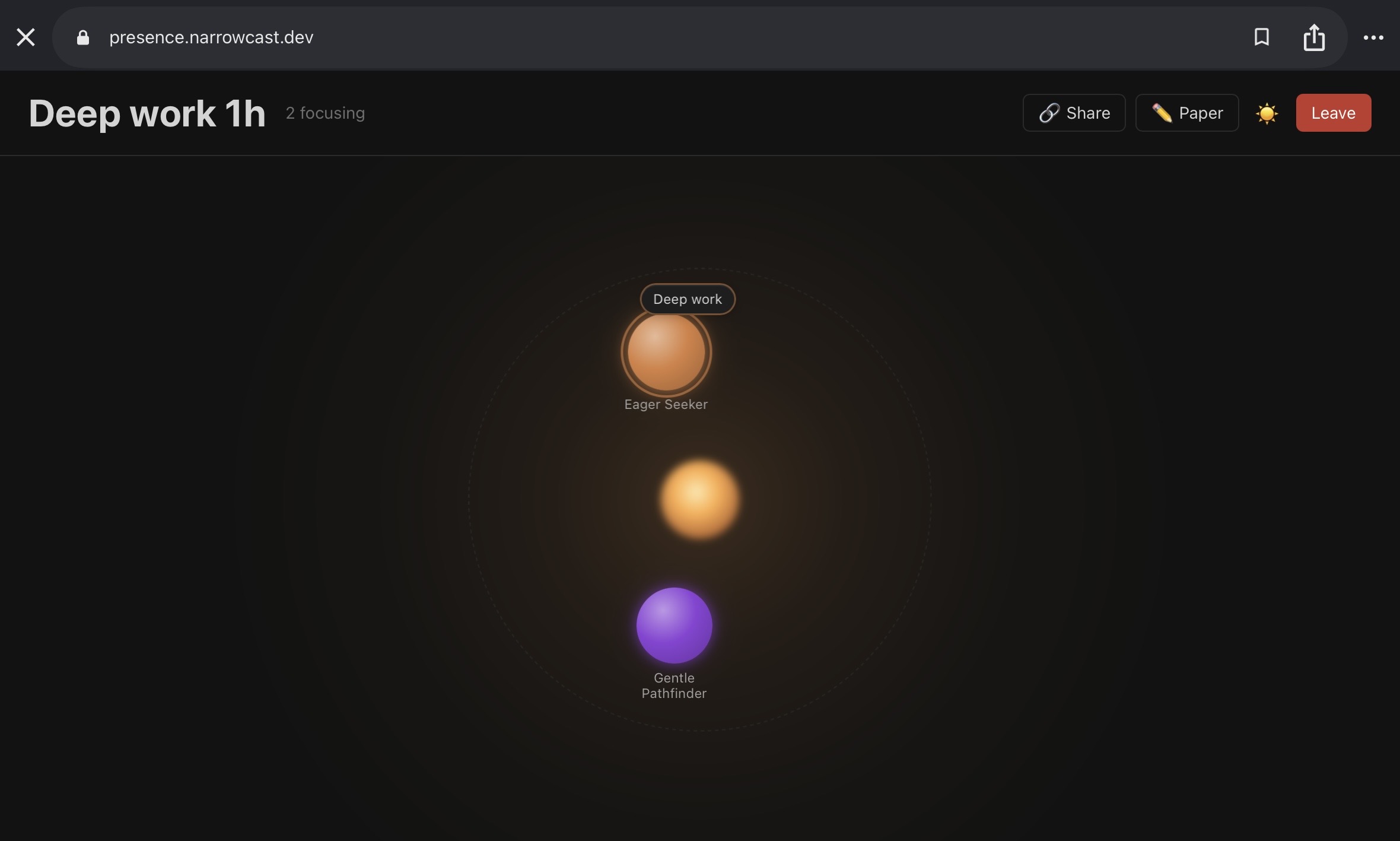
Group size. 1:1 pairing (the Focusmate model) creates direct accountability — one other person is counting on you to show up. Small groups (the Flow Club and Flown model) dilute that slightly but add social variety. Open rooms (presence's model) mean you're never waiting for a partner to be available, and you can drop in mid-session without disrupting anyone.
Camera requirements. Many platforms require or strongly encourage video. For some people, seeing faces reinforces presence and adds accountability. For others — particularly those with camera anxiety or Zoom fatigue — being on video creates performance self-consciousness that works against focus. Frequent video call users report fatigue at notably higher rates than less frequent users, with 26% of regular users affected. Camera-free options use other signals: status text, breathing animations, shared timers. The core mechanism — knowing others are present and working — stays intact.
Cost. Options range from free (BuckleTime, StudyStream, YouTube livestreams) to $5-10/month (Focusmate) to $30-45/month (Flow Club, Flown, Caveday). Higher cost often comes with professional facilitation and community features.
Community vs. anonymity. Some people want recurring partners, relationships, a sense of belonging to a group. Others want to drop in, focus, and leave without social overhead. Both are valid.
presence sits specifically in the camera-free, drop-in corner: breathing bubbles and a 2-word status replace video feeds, so you feel the ambient presence of other people working without the self-consciousness of being on screen. For a detailed comparison of options, see Focusmate Alternatives: Camera-Free Body Doubling Apps Compared.
Tips for Effective Body Doubling Sessions
The structure of a body doubling session matters as much as the tool you use. Declaring your task, setting a timer, and keeping conversation minimal are the three things that consistently separate productive sessions from ones that drift. Here's what research and practitioners recommend.
Declare your task before starting. Saying out loud (or typing into a check-in) what you'll work on creates a micro-commitment. It's a small act of externalizing intention, and it meaningfully increases follow-through. The Hallowell Center's accountability group model starts every session this way for this reason.
Set a timer. 25, 50, or 90 minutes — match it to your usual work rhythm. A timer handles time blindness (especially relevant for ADHD), creates a natural end point, and removes the low-grade mental overhead of wondering how long you've been at it. Most virtual coworking platforms handle this automatically.
Keep conversation minimal. Body doubling is not socializing. A brief check-in at the start (what are you working on?) and a brief check-out at the end (how did it go?) is the model. Silence during work is the point. If a session drifts into chat, the focus benefit evaporates.
Match your energy to the format. Feeling social and energized? A facilitated group session with video might work well. Feeling depleted or overstimulated? A camera-free room or a "study with me" stream will serve you better. Using the wrong format for your current state makes things worse, not better.
Track what works for you. Some people focus better with the direct accountability of 1:1 pairing; others find the ambient presence of a larger room less pressured and more effective. Experiment across a few methods before deciding what's yours.
Don't force it. Body doubling isn't the right tool for every task or every mood. Complex creative work requiring deep solitude sometimes gets worse with social presence nearby. Use body doubling for the tasks you keep avoiding — the email pile, the form, the report you've started three times. For the deep work you're already motivated to do, you may not need it.
Frequently Asked Questions
- Does body doubling work for people without ADHD?
- Yes. Body doubling is grounded in social facilitation — a psychological effect first documented in 1898 and replicated consistently since. It applies to everyone, not just people with ADHD. Remote workers, students, and freelancers all report improved focus when working alongside others, whether in person or online. ADHD is where the technique was named, not where its benefits stop. See the Who Benefits section for more.
- Can you body double online?
- Yes. Virtual body doubling works through video calls, virtual coworking platforms, and "study with me" livestreams. A 2024 Neurodiversity.org study of 117 adults found that virtual body doubling helped participants sustain focus for 60+ minutes, up from under 30 minutes before they started. The presence doesn't need to be physical to work. See 6 Practical Methods for options.
- Do you need a camera for body doubling?
- No. The core mechanism is knowing someone else is present and working, not seeing their face. Camera-free platforms like presence use status indicators and ambient cues instead of video. For people who find video calls draining, going camera-free can actually improve focus — removing the self-consciousness that undermines it. See What to Look For for more on camera requirements across platforms.
- Is body doubling scientifically proven?
- No large-scale randomized controlled trials exist yet. But body doubling builds on social facilitation theory — over 60 years of replicated research — and on dopamine pathway activation from social presence. A 2023 ACM SIGACCESS study (n=220) and a 2024 Neurodiversity.org study (n=117) provide direct emerging evidence. The honest answer is: strong theoretical grounding, promising early evidence, no definitive RCTs. See The Science section for detail.
Human brains focus better in the presence of other humans. That's not a productivity hack — it's how we're wired. Body doubling makes that ancient mechanism available anywhere, any time, with whoever is around — or whoever is online.
You have more options than ever: coffee shops, friend calls, virtual coworking rooms, livestreams, camera-free focus spaces. The best one is the one you'll actually use. Start with whatever removes the most friction between you and starting.